

Voice Disorders and Laryngology
Patients with hoarseness, loss of voice, difficulty singing or speaking are evaluated at either office. We are equipped with state-of-the-art voice laboratories at all of our offices. The key to the successful management of voice disorders requires a precise diagnosis. The study of the larynx (called laryngology) is in its infancy. We are just now beginning to understand the complex relationships of the larynx (voice box) to a number of related conditions such as reflux disease. To properly treat patients with the symptoms of hoarseness, voice change, difficulty singing, or voice weakness, we require a detailed, comprehensive evaluation that begins with our voice questionnaire. This can be downloaded for your use prior to our evaluation.
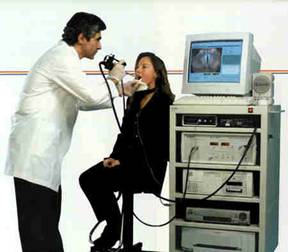
Dr. Kerner reviews the detailed history prior to an examination. We utilize specialized diagnostic equipment in our voice laboratory. The examination consists of a complete head and neck examination, a vocal capability battery if indicated and a videostroboscopy. The key to successful treatment outcomes is a precise diagnosis. We cannot accurately reach the appropriate diagnosis without a complete evaluation.
| Videostroboscopy We specialize in treating patients that have difficult to diagnose voice problems, voice weakness, and vocal cord paralysis, and professional voice users such as singers, actors, performers, teachers and attorneys. |
 |
Treatment Options
Most patients are successfully treated with a combination of medical therapy consisting of voice and/or speech therapy, in addition to medications for underlying medical problems. We work closely with speech therapists, voice coaches, and other voice specialists to assist in the rehabilitation process. In many cases, this type of therapy is far more important than surgery. Of course, all treatment plans are devised on an individual basis. Reflux is by far and away the number one cause of vocal problems in most patients. It is a contributor to vocal cord lesions, hoarseness and a myriad of voice disorders.
Patients with surgical problems such as suspicious lesions on the vocal cords, cysts, masses, or paralysis can be readily treated with microsurgical techniques. Our surgical techniques utilize microscopic cold knife surgery of the vocal cords termed “phonomicrosurgery.” Patients undergo this type of procedure as outpatients, and are discharged within a few hours of the procedure. For patients with papillomas Dr. Kerner utilizes state-of-the-art instrumentation to perform microlaryngeal phonosurgery.
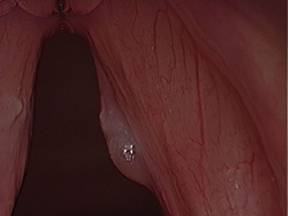
Example of right vocal cord lesion just prior to surgical removal in a professional singer
The postoperative care varies depending on the exact surgery performed, but in general, most patients are put through a three-part rehabilitation regimen following surgery.
The first phase of the recovery and rehabilitation involves complete voice rest for 48-72 hours. This depends on the type of surgery performed and the extent of healing required. The second phase of the rehabilitation process begins after 10 to 14 days after surgery. This involves gradual reintroduction of voice use with absolute avoidance of behaviors such as yelling, talking on the telephone, or lecturing.
In this second phase, voice therapy is introduced, and a vocal hygiene program is initiated that involves behavior modification, medical therapy and close follow-up. Phase 3 of the rehabilitation process begins approximately 12 weeks (3 months) after surgery.