
Sinus and Nasal Center-Setting a New Standard for Sinus and Nasal Care in Southern California
Our mission is to provide highly specialized medical and surgical care in a setting that always puts patients’ first. We work to achieve this by combining innovative treatment techniques with heartfelt compassion and guidance. Our greatest satisfaction comes from helping our patients lead healthier, happier lives.
Dr. Kerner has a practice unlike virtually any other in the nation. We have set the highest standards of care for our patients by utilizing the following principles: Most highly experienced, trained specialists in the Southern California region using State-of-the-art, on-site diagnostics including CT imaging, nasal endoscope and allergy testing. We provide individualized treatments that produce highly effective, lasting results. We also offer the latest cosmetic solutions for nasal reconstruction and enhancement. Our practice has an unsurpassed commitment to patient education and continuing education. We provide this in an environment that exceeds your expectations for comfort and convenience.
The septum divides the nose into two nasal cavities and the paired “paranasal” sinuses drain into small pre-chambers known as transitional spaces within the nose. The basic physiology of the nose and sinuses is that mucus which is produced by the cells and membranes lining the sinus cavities and nose can become diseased. This can involve either recurrent infections or can evolve into a chronic condition that is poorly responsive to medical therapy.
When the linings become diseased or infected this is referred to as acute sinusitis. The hallmark of acute sinusitis is facial pain, purulent nasal drainage, nasal congestion, and sometimes fevers and fatigue. Most sinus infections begin like the common cold, but when symptoms persist for 7 to 10 days, we consider this to be a sinus infection, usually caused by bacterial infection. In a very small percentage of cases, complications can occur which can lead to eye (orbital) or brain (meningitis) infections. The primary treatment is antibiotics. When infections recur or symptoms such as facial pain or pressure, nasal obstruction and congestion, and chronic nasal drainage occur, we call this chronic sinusitis.
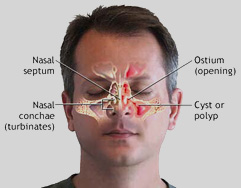
To assist in making a precise diagnosis, we ask our patients to complete a comprehensive history of their sinus problems. Many associated conditions such as asthma and allergies contribute to sinus disease so the entire situation needs to be reviewed to provide the highest level of care. This can be accessed at our web site under forms and completed prior to your visit or delivered to us via e- mail.
At your office visit, the detailed form is reviewed by Dr. Kerner prior to an examination. In the course of the examination, we utilize state-of-the art diagnostic nasal endoscopes to look directly at the drainage areas of the nose.
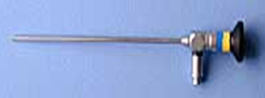
Nasal endoscope
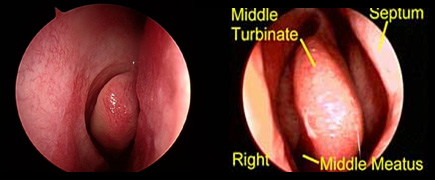
Normal anatomic view of the nose with an endoscope
This gives us the ability to culture drainage and make a precise diagnosis, identify anatomic abnormalities such as septal deviations, nasal polyps or mucosal abnormalities and plan further diagnostic studies.
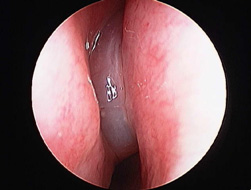
The shiny growth in the nose is a nasal polyp
The next diagnostic study is a high resolution computed tomography scan or CT scan.
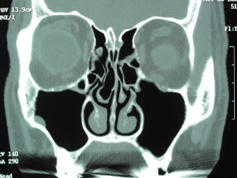
This helps us identify anatomic abnormalities that are not readily visible with nasal endoscopes .Utilizing a combination of the patient’s history, physical examination with the nasal endoscope in the office, and a CT scan using the latest 64 slice scanner technology, a concise treatment plan is individualized for each patient.
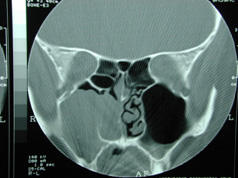
Abnormal CT with fungal disease filling the right side of the sinus
Our treatment protocols are custom-tailored to the individual patient. We utilize state-of-the-art therapeutic agents to treat sinus problems medically. When medical therapy fails surgery may be recommended. Again, each patient is different so the surgical plan is customized to correct anatomic deformities, and resolve the conditions that will allow the medical therapy to be effective.
Patients with history suggestive of allergy or asthma are referred to the appropriate sub specialists. We work closely with a number of allergy and pulmonary sub specialists to provide the most up-to-date and optimal medical therapy.
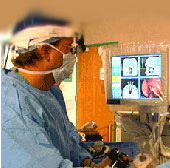
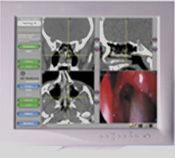
Dr. Kerner is also one of only a few surgeons trained in the latest minimally invasive technology-balloon sinuplasty.
Minimally Invasive Sinus Treatment: Entellus Medical – XprESS Multi-Sinus Dilation Tool
The XprESS Multi-Sinus Dilation Tool is the latest advancement available to ENT surgeons to more safely and effectively treat sinus disease and disorders. XprESS is an FDA approved instrument designed to access and treat the openings of the frontal, maxillary, and sphenoid ostia. This results in clearing these blocked sinuses, restoring normal sinus drainage and function, and preserving anatomy and mucosal tissue. This great new device is fashioned after a tool these doctors have been using for 20 years, a sinus seeker. XprESS, in essence, is a sinus seeker with an inflatable balloon on the end that also has integrated suction and irrigation. The end of the XprESS is also malleable to allow Dr. Kerner to bend and shape the tip as necessary giving him greater control and precision when operating on his patients.
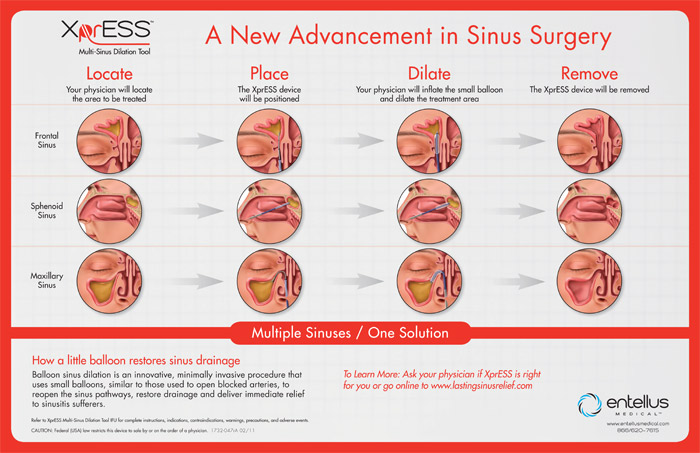
The Entellus Medical - XprESS Multi-Sinus Dilation Tool has been proven to be safe, effective, and durable in treating patients suffering from sinus disease and disorders.
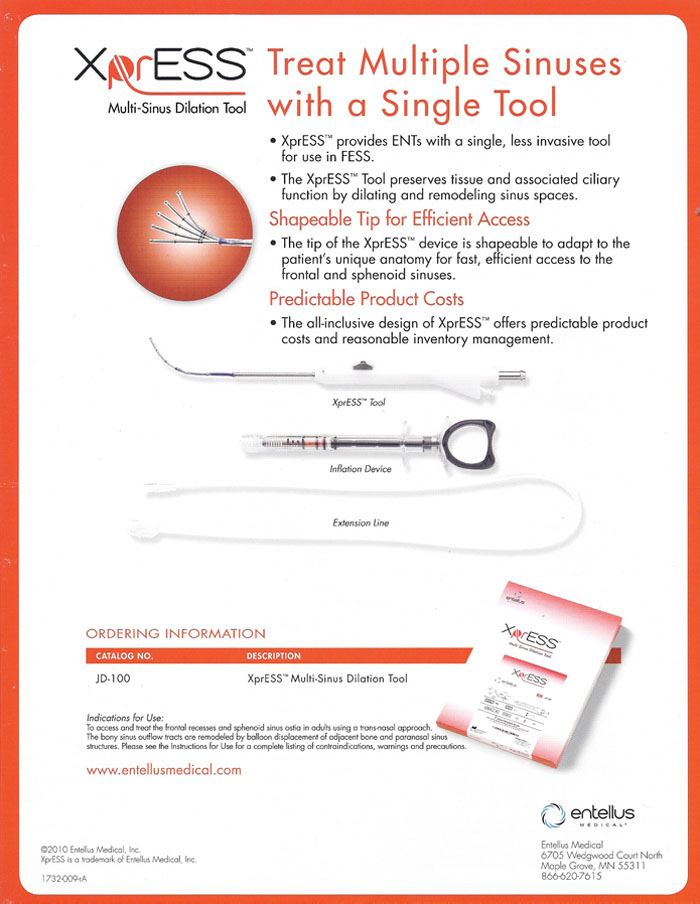
XprESS Multi-Sinus Dilation Tool - Patient Information


This Just In!!
Dr. Kerner is now offering a brand new treatment option to his patients suffering from mild to moderate sinus disease.
Are you stuck constantly taking medications such as nasal sprays, decongestants, steroid sprays, antihistamines, and other treatments with little or no relief? Do you have sinus infections multiple times a year? Are you worried or concerned about going to the operating room to treat your sinus problems? If you answered “Yes” to any of these questions, talk to Dr. Kerner to see if you are a candidate for an in-office sinus balloon procedure.
Applications
Our complication rate using this modern surgical approach pioneered by Dr. Kerner is virtually zero. Occasionally some postoperative bleeding is encountered, but in the last 3500 cases, there have been no cerebrospinal fluid leaks or eye injuries. Our revision surgery rate over the past three years has fallen to below 6%. The national average is somewhere between 25 to 30%.
For patients suffering from nasal obstruction, we utilize minimally invasive techniques for correcting nasal obstruction. This includes the use of laser technology and radio frequency technology for turbinate reduction, and endoscopic septoplasty requiring no nasal packing. For patients suffering from nasal obstruction due to valve collapse, we perform a minimally invasive reconstruction procedure that is highly successful in improving nasal breathing. Even patients requiring multiple procedures at the same time are usually back to work within five days. Our postoperative care regimen can be downloaded from our forms section.
Radio frequency Treatment of Chronic Nasal Obstruction
Turbinate procedures are performed with either the KTP laser, a powered microdebrider or radio frequency tissue reduction. Virtually all surgeries are performed with no nasal packing. We begin a nasal irrigation regimen the day after surgery, and depending on the individual situation, certain medications are prescribed. Most patients report minimal pain, and only mild discomfort for the first 24 to 48 hours.
At our nasal and sinus center, we prefer radio frequency turbinate reduction since it is a fast, effective way to relieve chronic nasal obstruction due to enlarged turbinates without the pain and inconvenience associated with traditional techniques. Unlike using cautery or laser approaches, radio frequency treatment has continuous temperature, power, and impedance monitoring to provide Dr. Kerner with complete control over the procedure. The radio frequency treatment can be performed in an outpatient setting under local anesthesia. Due to the partially insulated electrode and the controlled temperature used in treatment, the delicate mucosa is preserved and patients experience minimal, if any, crusting and bleeding. The procedure itself typically takes less than two minutes per turbinate. No nasal packing is required and most patients do not require any kind of postoperative analgesics.
My life has been completely changed! I’m breathing clearly through my nose, my headaches are gone and I can smell the flowers in the garden…R.S. 49 year old female --nasal and minimally invasive sinus surgery
If I had known how easy sinus surgery could be I would not have waited 20 years…A.T. 67 year old Male --balloon sinuplasty patient
After years of breathing problems, sinus infections, antibiotics, and constant use of sprays and pills, I can finally sleep through the night and get through the day without any medicine. Surgery completely changed my life! S.M. 37 year old female --septoplasty and sinus surgery patient
I had 16 previous surgeries for nasal polyps, asthma and infections. Dr. Kerner did my last surgery 7 years ago. I can breathe through my nose, smell the grass, and have had no return of polyps…G.W. 51 year old male --Instatrak guided revision sinus surgery 2000.
My new nose is perfect. It looks completely natural. I can also breathe like never before! A.P. 22 year old hair stylist --rhinoplasty and nasal reconstruction for breathing problems.
According to the National Institute of Allergy and Infectious Diseases
Sinusitis means your sinuses are infected or inflamed. Your sinuses are hollow air spaces within the bones surrounding the nose. They produce mucus, which drains into the nose. If your nose is swollen, this can block the sinuses and cause pain and infection.
Sinusitis can be acute, lasting for less than four weeks, or chronic, lasting much longer. Acute sinusitis often starts as a cold, which then turns into a bacterial infection. Allergies, pollutants, nasal problems and certain diseases can also cause sinusitis.
Symptoms of sinusitis can include fever, weakness, fatigue, cough and congestion. There may also be mucus drainage in the back of the throat, called postnasal drip. Treatments include antibiotics, decongestants and pain relievers. Using heat pads on the inflamed area, saline nasal sprays and vaporizers can also help.
According to the American Academy of Otolaryngology – Head and Neck Surgery
Antibiotic Treatment For Sinusitis
Antibiotics are labeled as narrow-spectrum drugs when they work against only a few types of bacteria. On the other hand, broad-spectrum antibiotics are more effective by attacking a wide range of bacteria, but are more likely to promote antibiotic resistance. For that reason, your ear, nose, and throat specialist will most likely prescribe narrow-spectrum antibiotics, which often cost less. He/she may recommend broad-spectrum antibiotics for infections that do not respond to treatment with narrow-spectrum drugs.
Acute Sinusitis
In most cases, antibiotics are prescribed for patients with specific findings of persistent purulent nasal discharge and facial pain or tenderness who are not improving after seven days or those with severe symptoms of rhinosinusitis, regardless of duration. On the basis of clinical trials, amoxicillin, doxycycline, or trimethoprim–sulfamethoxazole are preferred antibiotics.
Chronic Sinusitis
Even with a long regimen of antibiotics, chronic sinusitis symptoms can be difficult to treat. In general, however, treating chronic sinusitis, such as with antibiotics and decongestants, is similar to treating acute sinusitis. When antibiotic treatment fails, allergy testing, desensitization, and/or surgery may be recommended as the most effective means for treating chronic sinusitis. Research studies suggest that the vast majority of people who undergo surgery have fewer symptoms and better quality of life.
According to the American Cancer Society
What Are The Key Statistics About Nasal Cavity and Paranasal Sinus Cancers?
Cancers of the nasal cavity and paranasal sinuses are rare. About 2,000 people in the United States develop cancer of the nasal cavity and paranasal sinus each year. Men are about 50% more likely than women to get this cancer. Nearly 80% of the people who get this cancer are between the ages of 45 and 85. These cancers also occur much more often in certain areas of the world such as Japan and South Africa. About 60% to 70% of cancers of the nasal cavity and paranasal sinuses occur in the maxillary sinus; 20% to 30% in the nasal cavity; 10% to 15% in the ethmoid sinuses; and less than 5% in the frontal and sphenoid sinuses.
|